A visualized creative process, not a chat window
- A mensuration canon narrows the Art of Fugue reference to Contrapunctus VII, augmentation and diminution, rather than subject and answer at the fifth.
- Rules 2 and 4 both describe ostinato behaviour: the pedal returns material on a fixed cycle.
- Every module phrase has to stand alone as a canon subject, which is a harder constraint than a fugue subject usually carries.
- Sketch the four-voice stack over a sparse subject before committing to the canon.
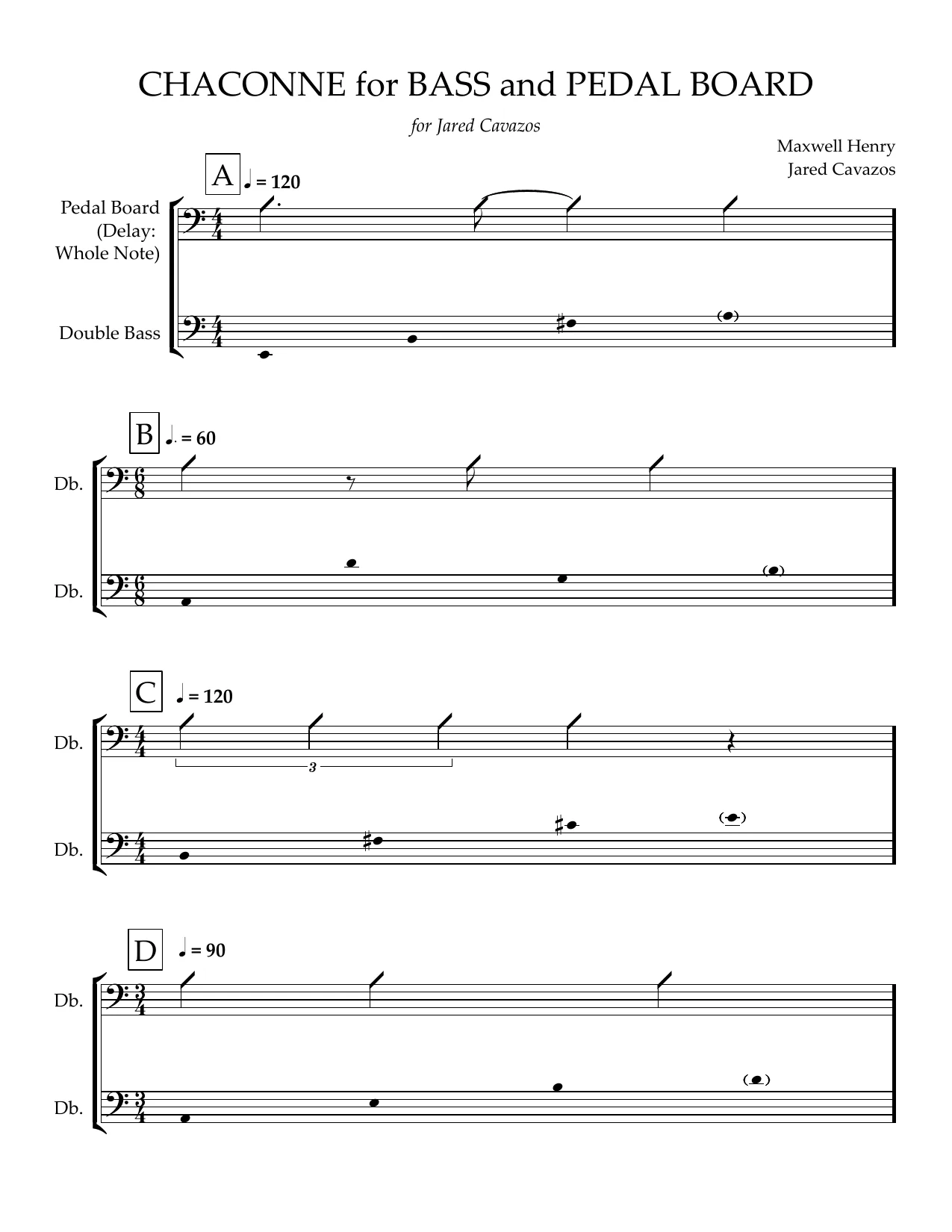
The delay is a ground, not a set of fugal entries. Rule 1 is retired: the form becomes a chaconne, a repeating bass the pedal generates live with variations flowing over it. Rules 2, 3 and 4 survive unchanged, because a sparse subject locked to the delay cycle is what a ground needs.
 Draft
Draft
Chaconne for Bass and Pedal Board
Full draft · one page · unengraved
Chaconne for Bass and Pedal Board
2026 · for bass and delay pedal · with Jared Cavazos · 12′39″
It does not write the music
The assistant produces questions and observations based on your idea for the piece and your aesthetic blueprint.
Discover your piece as you write
As you continue to interact and update the assistant, the more it will understand your piece and learn your creative process.
Learn about your own process
There are canvas templates to visualize the composition process, without building your process from scratch.
Manage your network and career
Contacts
12 total · 1 overdue
| Name | Roles | Affiliation | Status | Next action | Health |
|---|---|---|---|---|---|
Priya Anand priya.anand@gmail.com |
Composer |
Tide Quartet |
Warm | Send score draft Oct 3 |
82 |
Jordan Ma jordanma.music@gmail.com |
PlayerComposer |
Tide Quartet |
Warm | − | 76 |
Marcus Webb |
PlayerComposer |
− | Cool | − | 54 |
Naomi Cole |
AttendeeComposer |
− | Warm | − | 68 |
Desmond Okafor |
Conductor |
Bell Ridge Sinfonietta |
Active | Outreach: send 7-day follow-up email Oct 5 |
91 |
Sofia Lindqvist |
Composer |
− | Cold | − | 38 |
Outreach
3 to reach out to
Wanted to reconnect, and ask you a quick question!
Groove Theory II
Oct 18, 2026 · 7:30 PM–10:00 PM · Scholes Street Studios
8 of 10 essentials answered.
Still needed: Recording plan · Load-out time
https://…/#portal/kJ7pQ2xN4vTb8mLdRf3wYs
Anyone with this link can read and edit the whole form, so treat it as the password.
Groove Theory II
Oct 18, 2026 · 7:30 PM–10:00 PM · Scholes Street Studios
8 of 10 essentials answered.
Groove Theory II
Oct 18, 2026 · 7:30 PM–10:00 PM · Scholes Street Studios
8 of 10 essentials answered.
1 flyer, 2 rehearsal photos
7 on the bill · 5 confirmed. Tapping RSVP writes back to the contact record.
Groove Theory II
Oct 18, 2026 · 7:30 PM–10:00 PM · Scholes Street Studios
8 of 10 essentials answered.
Naming a contact on an entry also writes the touchpoint onto that person, so the concert log and the relationship history never drift apart.
New newsletter
Studio Roundup · custom sections
Save version (top bar) keeps a snapshot you can restore. Saving a draft does not create one.
No versions saved yet.
Groove Theory II premieres in October, and it might be the best thing I've written this year. Come hear it.
Toggle who gets the test (subject prefixed [TEST]).
Every contact in the group with an email. Enabled once the issue is Approved.
Set status to Approved to enable.
Groove Theory II premieres in October, and it might be the best thing I've written this year. Come hear it.
Hey friends, October is a big one this year. Groove Theory II premieres and the studio has been loud all month getting there.
Everyone in one place
Players, ensembles, venues and conductors in one record.
Keep your network active
Track and draft communications and build newsletters to keep contacts up to date.
Manage your concerts
Plan and track your concerts and communications with your players and venues.
Your virtual team
Putting one to work
virtual-agency folder in Claude Code (it is its own project, beside this one).deliverables/, with a dated sprint file recording what shipped.Music Marketing Agent
Department: Music · Reports to: Maxwell Henry · Peer: Social Media Agent
Drives attendance, press coverage, and audience development for Maxwell's concerts and projects. It owns outcomes, not content. It produces strategy and outreach materials. Maxwell reviews and approves everything before it sends. Nothing goes out without his sign-off.
- Never use em dashes. Restructure with a colon, a period, or reorder the clause.
- Active voice. Flip "X was done by Y" to "Y did X."
- Short, direct sentences. One idea per sentence.
- The ask is warm and friendly, not transactional. Invite, do not solicit.
- Outreach strategy: who to contact, in what order, through what channel
- Tiered outreach copy: close contacts, peers, and cold contacts each get a different version
- Email campaigns for alumni networks, venue lists, and mailing lists
- Performer and collaborator coordination materials
- Series and brand framing, positioning recurring events as an ongoing series
- Social media posts (briefs the Social Media agent instead)
- Design (flags for Canva or a designer)
- Booking and contracting, entirely
| Gmail MCP | Draft and stage outreach emails. Stage only, Maxwell sends. |
| Composer Assistant MCP | Reads Maxwell's aesthetic identity for press and institutional copy. |
| WebSearch | Research composition department contacts, venue emails, press targets. |
Sprint 01: Groove Theory Deliverables
Agent: Music Marketing · Campaign: Groove Theory, Classical Music with a Pulse
Sprint date: 2026-05-28 · Status: Complete, pending Maxwell's sends
Ready to send. Performers swap in their own name where relevant.
Design your team
Create your own team members to assist in any way you need.
Custom job descriptions
Tell your team what you need and how you need it.
Supervise your team
When your team completes work, you review, revise, and implement.
Under the hood
What the tool runs on
| Component | State | Detail |
|---|---|---|
| MCP server | In use | ~25 tools: project context, artifact persistence, music21 score analysis, voice-leading checks, retrieval. |
| Score watcher | In use | Writes a JSON sidecar per score file and embeds it. Verified end to end on this piece's sketch. |
| Retrieval | In use | Semantic search over an embedded personal library of scores and reference material, findable by structural description rather than filename. |
| Evaluation protocol | In use | Rubric annotation plus binary hallucination and technical-claim checks, with the two-run comparison as the primary evaluation artifact. |
| Notation rendering | In use | Verovio in the browser: note-level selection, playback with a following cursor, fragment capture into an ideas library. |
| Engraving and OMR | Implemented | MuseScore engraving and Audiveris optical recognition, written and self-tested as external subprocesses. |
One ledger for the lessons, the pay, and the plan
Tuesday, September 15
- 4
8:00–9:00⋯MIRA OKONKWO60 min · Private✓ CompletedLate cancelNo-showExcused
-
9:30–10:45Performance Practice Seminar75 min · Personal · Rm 2441
-
11:00–12:15Keyboard Skills (TA)75 min · University · Rm 1351
-
3:30–4:15⋯Nora Castellanos45 min · Harbor Piano✓ CompletedLate cancelNo-showExcused5×Tuesday, September 15, 3:30–4:15 PM
Nora Castellanos
45 min · Harbor PianoWhat happened✓ CompletedLate cancelNo-showExcusedFollow-upWhat needs follow-up? e.g. confirm next lesson, bring music- ReschedulePick a new time on the calendar. This one is marked excused.
- Notify familyOpen your email or texts with a message ready
- Open studentProfile, rate, lessons and notes
-
4:15–5:00⋯Eli Ferreira45 min · Harbor PianoLate cancel · billableUndo
-
5:00–5:30⋯Sam Whitaker30 min · Harbor PianoExcusedUndoReschedule
-
7:15–8:00⋯Clara Voss45 min · PrivateCompletedUndoChopin Nocturne in E-flat, voicing the melody over the left hand. Pedal changes are cleaner than last week.
Hours
| Student | Lessons | Hrs | Gross |
|---|---|---|---|
| Eli Ferreira | 2 | 1.50 | $67.50 |
| Iris Nakamura | 2 | 1.50 | $67.50 |
| Lucy Hart | 1 | 0.75 | $33.75 |
| Maya Chen | 2 | 1.50 | $67.50 |
| Nora Castellanos | 1 | 0.75 | $33.75 |
| Owen Brooks | 2 | 1.50 | $67.50 |
Harbor Piano · Aug 24 to Sep 6
| Student | Dates | Lesson length | Total |
|---|---|---|---|
| Eli Ferreira | 8/25, 9/1 | 45 min | 1.5 hrs |
| Iris Nakamura | 8/24, 8/31 | 45 min | 1.5 hrs |
| Ivy Sorensen | X | X | X |
| Lucy Hart | 9/3 | 45 min | 45 min |
| Maya Chen | 8/24, 8/31 | 45 min | 1.5 hrs |
| Nora Castellanos | 9/1 | 45 min | 45 min |
| Owen Brooks | 8/27, 9/3 | 45 min | 1.5 hrs |
| Sam Whitaker | 8/25, 9/1 | 30 min | 1 hr |
| Theo Park | 8/31 | 45 min | 45 min |
| 13 lessons | 9.25 hrs | $416.25 | |
Students
- Private
- Ada Kim$65/hr
- Clara Voss$65/hr
- Hannah Park2 cancels$60/hr
- JONAH ELLIS$70/hr
- JULIAN REYES$70/hr
- Leo Brandt$60/hr
- MIRA OKONKWO$70/hr
- Harbor Piano
- Eli Ferreira$45/hr
- Iris Nakamura$45/hr
- Ivy Sorensen14 wks idle$45/hr
- Lucy Hart$45/hr
- Maya Chen$45/hr
- Nora Castellanos$45/hr
- Owen Brooks$45/hr
- Sam Whitaker$45/hr
- Theo Park$45/hr
- Maple Music School
- Felix Moreau$40/hr
- Ruby Alvarez$40/hr
Nora Castellanos
Two years of Suzuki violin before switching to piano. Reads treble clef fluently; bass clef is newer.
- Bartók · Mikrokosmos No. 78November studio recitalPerformance ready
- Clementi · Sonatina in C, Op. 36 No. 1Polishing
- Burgmüller · Arabesque, Op. 100 No. 2Learning
- Kabalevsky · ClownsAssigned
- Hands separate on the Clementi, metronome at 88. Loved the left-hand ostinato.
- Bartók memorized. Talked about playing it for the November studio recital.
- First lesson of the term. Placement and warm-ups; assigned the Arabesque.
Booking
https://…/book/lessons-7f3a2c
CopyOpenTurn off
Tap the half-hours you are happy to teach in. Your recurring lessons are already blocked out, so what is left is genuinely free.
Book a piano lesson
Piano lessons for all ages, in person.
All times are America/Chicago. At least 24 hours' notice, up to 30 days ahead.
One week is already taken. Oct 15 is not available at this time, so you would need a different time that week. The other 7 will be booked.
What the semester has to earn
A range, not a number. Teaching income moves with cancellations, holidays and recital season. The floor is what the month has to clear; the ceiling is what a good month looks like.
| Net target (midpoint) | $4,500 |
| Less TA stipend (gross) | −$3,261 |
| Must come from teaching | $1,239 / mo |
The real rate shrinks the case, it doesn't erase it
Harbor Piano pays $45/hr against the teacher's own $60–70. The gap between an all-private and an all-contract month is 2 hours a week. Moving a student to the private roster still buys back real practice time.
How many students the floor actually needs
Log a lesson in one tap
Each lesson is marked held, cancelled or excused, and every hour total, pay sheet and student record updates from that tap.
Submit hours without a spreadsheet
Each employer gets its own pay-period sheet, and a submitted period locks so hours already sent never change.
Plan the studio around real numbers
An income target turns into weekly teaching hours and a roster size, and families book open times from one link.
Every relationship, event and follow-up in one place
September 1
-
10amCo-WorkingUntil 4pm · Sprout calendar · not in your hours
-
2pmVol. 4 run-of-show callUntil 2:30pm · Your calendar · Events & Programs
-
1 hr⋯Rosa DelgadoEvents & Programs · Follow-up · Send set times to the Vol. 4 lineup✓ DoneUndo
-
1 hr⋯Imani Shaw4d lateOutreach · Follow-up · Follow up on the membership scholarshipNot done Mon 8/31, moved here at midnightCompletePushFollow up
-
1 hr⋯Quiet Hours SocialEvents & Programs · Follow-up · Send the host portal link✓ DoneUndo
-
2 hrs⋯Draft the fall grant reportGrants & Fundraising · TaskCompletePushFollow up
-
30 min⋯Order Vol. 4 wristbandsAdmin · Task✓ DoneUndo
- Maya Chen: Invite to Vol. 4 as a reader
- Kai Brennan: Thank-you note for the scholarship gift
- Vol. 5 flyer
- and 1 more
Contacts
| Name | Type | Affiliation | Status | Next action | Health |
|---|---|---|---|---|---|
Ada Kim ada.kim@example.com | Music | 🗓 Vol. 4 | Active | Confirm backline Sep 3 | |
Jonah Reyes jonah.reyes@example.com | Art | 🏢 Fern & Fold | Warm | − | |
Maya Chen maya.chen@example.com | AttendeeCoworking | 🗓 Vol. 4 | Warm | Invite as a reader Sep 4 | |
Rosa Delgado rosa@example.com | Event Host | 🏢 Night Garden | Active | Send set times Today | |
Theo Park theo.park@example.com | Partner | 🏢 Low Tide Records | Cold | − | |
Imani Shaw imani.shaw@example.com | Coworking | − | Warm | Scholarship follow-up 4d overdue |
Sprout N Tell Vol. 4
Sprout N Tell Vol. 4
and get tonight's program
Velvet Static
Sprout Monthly · September 2026
Sprout N Tell Vol. 4 is here: eight artists and musicians, one night, Friday, September 11. Bring a friend.
✓ Use thisSocietySprout Monthly
September 2026
Sprout N Tell Vol. 4 is here: eight artists and musicians, one night, Friday, September 11. Bring a friend.
Local artists on the walls, short sets all night, and a room full of people you have not met yet.
RSVP →Outreach
Low Tide Records
| Tier | B · monthly cadence |
| Why they fit | Independent label with a listening-room series. Two of their artists already play Sprout N Tell. |
| Primary contact | Theo Park · label manager · theo.park@example.com |
First-touch message
Problem
Relationships were tracked in a spreadsheet, follow-ups were forgotten, and events had no central coordination.
Solution
A full relationship and events management tool with automated assistance.
Outcome
Everything tracked and supported by a custom MCP server that uses Claude as a CRM assistant and n8n automations.
From funder research to a finished application
Grant Pipeline
Add a Grant
{
  "grantName": "Belonging Initiative",
  "funder": "Hudson Wellness Trust",
  "amount": 25000,
  "deadline": "2026-10-20",
  "status": "not_started",
  "applicationUrl": "https://hudsonwellness.example/belonging",
  ...
  "questions": [
    {
      "id": "hwt_q1",
      "category": "narrative",
      "question": "Who in your community feels most alone, and how do you reach them?",
      "hint": "Name the people and the place. No clinical terms.",
      "charLimit": 2000,
      "draft": ""
    },
    ...
  ],
  "tasks": [
    { "text": "Watch the recorded info session", "priority": "high", "dueDate": "2026-09-09" },
    ...
  ],
  "notes": "Score: 21/25 · Tier 1. Strong fit on belonging. Confirm the budget floor."
}
📌 Belonging is the health outcome here. Lead with people who arrive alone and come back, and keep clinical words out of i…
Copy this block and paste directly into the funder's portal.
========================================================
GRANT APPLICATION: Neighborhood Connection Grant 2026
FUNDER: Brooklyn Neighbors Fund
AMOUNT: $10,000
DEADLINE: Sep 30, 2026
STATUS: In Progress
========================================================

QUESTION 1 [ORG INFO]
Organization name, website, and year founded
────────────────────────────────────────
Sprout Society
sproutsociety.example
Founded in Brooklyn in 2019 as a free community space where neighbors meet up, work, and share their art.

QUESTION 2 [NARRATIVE]
Describe your organization and the neighborhood it serves.
────────────────────────────────────────
Sprout Society is a free, peer-led community space in Brooklyn, run by neighbors for neighbors who want more connection in their lives. Every week the doors open for Co-Working on Tuesdays and peer-led gatherings in the evenings, and a few times a year for Sprout N Tell, a night where local artists and musicians share their work with a room full of people who live nearby. Nobody pays to come in, nobody needs a referral, and nobody has to explain why they showed up. Most people arrive knowing no one and leave with a name, a reason to come back, and often a new friend who lives on the next block. Members lead most of what happens here: they host the gatherings, set up the chairs, greet people at the door, and decide what the space should try next. Over the summer, members hosted their own gatherings every week, from a Sunday walking group to a zine table. We started because so many neighbors told us the same thing, that they had lived in Brooklyn for years and still felt alone in it. A third space that asks nothing of you turned out to be what people were missing. This grant would keep the doors open more nights a week and help more of our neighbors find their way in.

QUESTION 3 [IMPACT]
How many neighbors did your programs reach last year, and how do you know?
────────────────────────────────────────
Last year, 312 neighbors came to Sprout N Tell, and 41 of them now come back every Tuesday to work side by side. We know because every guest signs in at the door, and our community records show who returns, not just who comes once.
Problem
No system to track the pipeline, document positioning, or manage the application lifecycle end to end.
Solution
A research and writing workspace where Claude identifies opportunities and tracks application process end-to-end.
Outcome
Find, research, and complete more grant applications in significantly less time.
See which flyers and links bring people in
Sprout N Tell Vol. 4
QR Code Scan Tracker · Sprout Society
September 11, 2026Door Sign-In
Door Sign-In
- Event
- Sprout N Tell Vol. 4
- Date
- September 11, 2026
- Type
- Signage · Front door
- Tracks to
- sproutsociety.example/track?qr=sprout-n-tell-vol-4-2026-door-sign-in
Daily Scans · Street Flyer
Live data · Street Flyer · Last refreshed 9/12/2026, 9:41 AM
Sprout N Tell Vol. 4
QR Code Scan Tracker · Sprout Society
September 11, 2026⚙ Manage Events & QR Codes
×⚙ Manage Events & QR Codes
×Problem
No way to know which marketing materials produced the greatest ROI.
Solution
Real-time scan tracking runs serverless on Vercel with a live analytics dashboard.
Outcome
The team now knows which placements actually drive engagement and can allocate print budget accordingly.
From a job posting to the next ones like it
Claude reads the posting and writes job.md in a new folder.
Not started 2
Drafted 2
Sent 2
Interview 1
Closed 1
Not started 2
Drafted 2
Sent 2
Interview 1
Closed 1
Portland, OR · in person, two evenings a week
Pay: $38 to $44 an hour
Deadline: October 9, 2026
Teaches Music Theory I and II in the evening program for adult learners.
Job posting
What the application asks for
Requirements 3 met1 unconfirmed1 gap
| Requirement | Kind | Read | Source | Your call |
|---|---|---|---|---|
| Teaches Music Theory I and II to adult learners | must | met | profile.md: Teaching | n/a |
| Three or more years of classroom or studio teaching | must | met | profile.md: Work history | n/a |
| Available two evenings a week, in person | must | met | notes.md | n/a |
| Experience with a learning management system | preferred | unconfirmed | not in profile.md | 5
Ran Canvas for two community classes, 2024 to 2025 Also save to profile.mdStrategy will refuse to claim this.
Kept off the documents, and asked as an open question.
|
| Master's degree in music theory or composition | preferred | gap | profile.md: Education | The fact, with where it comes from Strategy will refuse to claim this.
Kept off the documents, and asked as an open question.
|
In your words Claude never fills this
Harbor Point Music School
Part-time Theory Instructor
- Portland, OR, in person
- Two evenings a week
- $38 to $44 an hour
- Deadline: October 9, 2026
The job
Teaches Music Theory I and II in the evening program for adult learners. The posting asks for a resume, a cover letter, and ideas for the curriculum.
Qualifications
- Three or more years of teaching
- Learning management system experience preferred
- Master's degree preferred
The angleAmend
Lead with adult learners. Riley teaches the students this program exists for, so the letter opens there and the teaching record backs it up.
Lead order yoursAmend
- The evening program and the adults it serves
- Six years of studio and community teaching
- A listening-first unit plan for Theory I and II
Claims and their sourcesAmend
- Six years of teaching (profile.md: Work history)
- Theory, ear training, and composition (profile.md: Teaching)
- Canvas for two community classes (intake: your fact)
What stays outAmend
The master's degree: never claimed, and never apologized for. Performance credits, which this job does not ask about.
Open questions for Riley0 open
The posting asks for curriculum ideas. Is there a unit you have actually taught that the letter can name?
Refused: Master's degree in music theory or composition
You confirmed: Experience with a learning management system
Calls
- Header: Portland, OR
- Move: no
- Salutation: Dear Hiring Committee
- Salary: not set
Asks for
resume or CV, letter: required
Why this one
I came back to music as an adult, and an evening theory class is the one I wish I had found.
Edit the intakeSeptember 30, 2026
Dear Hiring Committee,
Adults who come back to music bring questions a textbook never answers, and those questions are why I teach. I am applying for the Part-time Theory Instructor position in Harbor Point Music School's evening program.
For ten years I have taught theory, ear training and composition in private studios and community classes, to students from eight to seventy…
September 30, 2026
Dear Hiring Committee,
Adults who come back to music bring questions a textbook never answers, and those questions are why I teach. I am applying to teach Theory I and II…2 I am applying for the Part-time Theory Instructor position in Harbor Point Music School's evening program.
For ten yearsFor six years3 I have taught theory, ear training and composition in private studios and community classes, to students from eight to seventy. I build each lesson around music my students already love, so every rule arrivearrives1 with a sound attached.
For Theory I and II, I would open each unit with a listening session and close it with a short composition, so students hear a concept before they name it.
Thank you for your time and consideration,
Riley Chen
September 30, 2026
Dear Hiring Committee,
Adults who come back to music bring questions a textbook never answers, and those questions are why I teach. I am applying for the Part-time Theory Instructor position in Harbor Point Music School's evening program.
For six years I have taught theory, ear training and composition…
Like Harbor Point Music School Part-time Theory Instructor · sent Sep 303 new since last scan
| Application | Steps | Needs you | |
|---|---|---|---|
| Westbrook Community Music Center Evening Theory and Musicianship Instructor |
23✓ Folder→✓ Copy→✓ Intake→✓ Strategy→Approve the strategy→CV→Letter |
2 changed sections to read1 open question |
Open |
| Tilikum Arts Collective Adult Education Music Instructor |
✓ Folder→✓ Copy→✓ Intake→✓ Strategy→Approve the strategy→CV→Letter |
1 changed section to read1 unconfirmed: Piano instruction |
Open |
| Alder Creek Community College Music Theory Adjunct |
✓ Folder→✓ Copy→Intake…→Strategy→Approve |
nothing yet | Open |
Where it stops
Each application runs Intake and Strategy, then waits for you to approve its strategy. Approving drafts from the plan, the same as any application. Nothing is signed off or sent without you. The others keep running while you work on the first one.
A job search with standing rules
It reads employers' own job boards, so no listing is stale, and culls by your rules for free before Claude scores what survives against the applications you already sent. Every dismissal takes a reason, and the next scan reads it.
A plan before a word is drafted
Claude reads the posting against your profile and lists every requirement with its source. You settle the angle, the claims, and what stays out, then approve the plan.
From draft to sent
Claude drafts from the approved plan and marks anything the plan can't source; only the marks you keep change the text. Signing off builds the Word file and PDF, and marking it sent keeps a read-only copy of what went out.

Draft it, approve it, publish it to Instagram
the
artistsPending Approval
Meet the artists on the walls at Vol. 4: Mara Lin paints the quiet parts of city life, and Jonah Reyes makes zines about growing up and growing back. Come see their work up close on Friday, September 11. 🌱
WorkingPending Approval
Quiet hours are for everyone. Co-Working is open every Tuesday from 10 to 4: bring a laptop, a journal, or just yourself. Swipe for a look inside. 💛
the
dateScheduled
Save the date: Sprout N Tell Vol. 4 is Friday, September 11, 7 to 10pm. Music, art, and a room full of people who get it. Come as you are.
line
upScheduled
The Vol. 4 lineup is here! Ada Kim, The Low Hums, Velvet Static, Sam Ortega, Mara Lin, and Jonah Reyes. Friday, September 11 at Sprout Society. Bring a friend. 🌱
morrowScheduled
Tomorrow night: six acts, one room, and a whole lot of heart. Doors open at 7. We saved you a seat.
line
upScheduled
The Vol. 4 lineup is here! Ada Kim, The Low Hums, Velvet Static, Sam Ortega, Mara Lin, and Jonah Reyes. Friday, September 11 at Sprout Society. Bring a friend. 🌱
the
dateScheduled
Save the date: Sprout N Tell Vol. 4 is Friday, September 11, 7 to 10pm. Music, art, and a room full of people who get it. Come as you are.
morrowScheduled
Tomorrow night: six acts, one room, and a whole lot of heart. Doors open at 7. We saved you a seat.
nightScheduled
Tonight! Doors open at 7. Sprout N Tell Vol. 4 starts now, and there is room for you.
Velvet Static · Sam Ortega
Mara Lin · Jonah Reyes
Problem
Planning, designing, and publishing content directly from phone to platform was cumbersome and inefficient.
Solution
Direct Instagram publishing via API, with a human approval step before anything posts.
Outcome
Replaced paid tools with one owned workflow.